
Florida Utility Tariffs Under Review by PSC
October 24, 2026 | Meridian Group Strategies
Florida Data Center Watch | Public Policy & Regulatory Oversight
Florida's effort to establish stronger financial protections for utility customers as hyperscale data center development expands has entered a critical phase.
On October 22, 2026, staff at the Florida Public Service Commission (PSC) issued recommendations concerning proposed large-load electric tariffs submitted by four of the state's investor-owned utilities: Florida Power & Light, Duke Energy Florida, Tampa Electric Company, and Florida Public Utilities Company.
These filings are intended to address a fundamental question: Who pays for the electrical infrastructure and generating capacity required to support extremely large electricity consumers, and how can existing ratepayers be protected from those costs?
The latest recommendations reveal four different regulatory approaches, several unresolved questions, and an important distinction between what utilities propose and what the Commission ultimately determines is sufficient.
The Commission is scheduled to consider these matters at its November 3, 2026, agenda conference.
Understanding Florida's New Large-Load Requirements
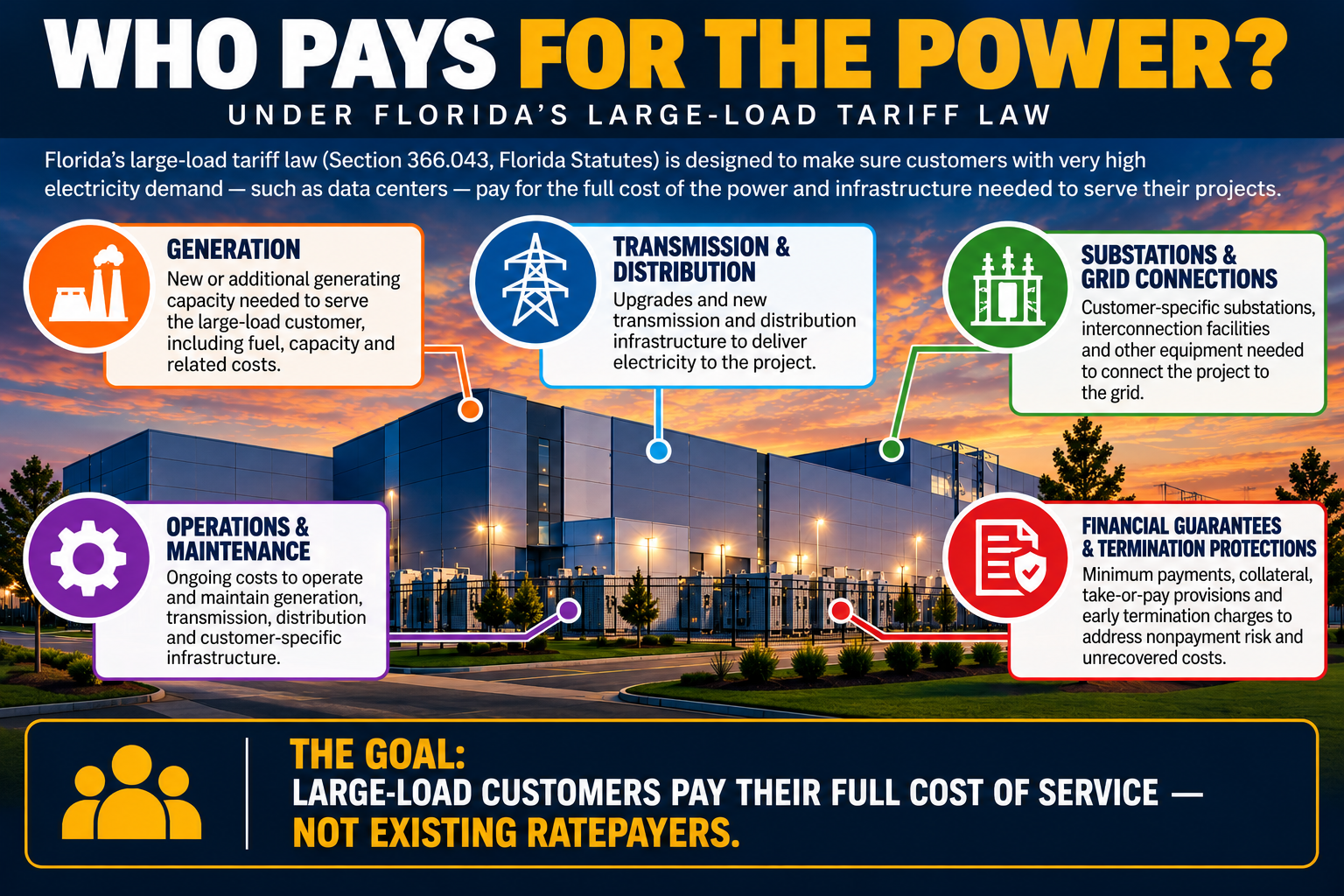
Florida's large-load tariff requirements, established under Section 366.043, Florida Statutes, generally address customers with anticipated monthly peak demand of 50 megawatts (MW) or more.
To put that threshold into perspective, 50 MW represents a substantial concentration of electricity demand at a single facility or project. Large-load customers can include hyperscale data centers, advanced manufacturing facilities, and other energy-intensive operations. The law requires covered utilities to establish tariffs that reasonably ensure these customers bear their full cost of electric service.
That includes costs associated with:
Connecting facilities to the electrical grid.
Additional generation capacity.
Transmission and distribution infrastructure.
Other infrastructure necessary to provide service.
Associated operations and maintenance.
Financial protections against customer nonpayment.
The objective is not to prevent large-scale electricity customers from connecting to Florida's grid. It is to establish financial safeguards so existing residential and commercial customers are not left paying for infrastructure built primarily to serve a new large-load customer. One important thing to keep in mind is that filing a tariff does not establish that the proposed protections are sufficient. That determination belongs to the PSC.
Duke Energy Florida: Staff Recommends Denial
PSC Docket No. 20260064-EI
Of the four proceedings, Duke Energy Florida faces the most significant staff recommendation. PSC staff has recommended denying Duke's proposed large-load tariff as filed while allowing the company an opportunity to submit a revised proposal. Two issues stand out.
1. Which customers are covered?
Duke's proposal applies to customers requiring at least 50 MW of firm electric service. PSC staff identified a potential problem with limiting the tariff to firm service because qualifying interruptible and curtailable customers also fall within the statutory requirements. This is important to understand because a large electricity consumer does not necessarily eliminate its infrastructure costs simply because some portion of its service can be interrupted.
2. Are existing commercial rates sufficient?
Duke proposed temporarily serving qualifying large-load customers through existing commercial rate schedules while implementing additional contractual protections.
The proposed structure includes:
A 20-year minimum contract.
Minimum demand commitments initially set at 75% of contracted capacity.
A minimum billing load factor of 60%.
Upfront infrastructure contributions.
Financial security and collateral requirements.
Early termination provisions.
Those provisions are designed to reduce the financial risk associated with serving extremely large customers. However, PSC staff concluded that Duke had not adequately demonstrated that the proposed rate structure would ensure each qualifying customer pays its full cost of service. Questions remain concerning the recovery of incremental generation and transmission costs.
Why this matters: A utility can require long-term contracts and substantial financial guarantees without necessarily demonstrating that every relevant infrastructure and service cost is being recovered from the customer responsible for creating that demand. Duke's proposal highlights the difference between financial security and full cost recovery. Both are important, but they address different risks.
Tampa Electric: A More Detailed Infrastructure Proposal
PSC Docket No. 20260146-EI
Tampa Electric submitted its proposed large-load tariff on September 30, 2026. PSC staff has recommended suspending the proposed tariff revisions to allow additional review.
Unlike Duke's approach, Tampa Electric's proposal identifies specific generation, storage, and transmission investments associated with its large-load service structure.
Its proposed LLCS-1 schedule incorporates costs associated with:
600 MW of energy storage.
600 MW of generating capacity through modernization of Big Bend Unit 4.
Transmission infrastructure associated with those resources.
A portion of broader utility system costs.
The proposed Large Load Customer Structure (LLCS-1) addresses the first 1,000 MW of cumulative large-load demand. A separate Large Load Customer Structure (LLCS-2) would apply beyond that threshold, incorporating additional generation, storage, transmission, and system-service costs.
The Ratepayer Question
Tampa Electric's approach raises several questions that deserve careful examination.
How will the utility allocate infrastructure costs between large-load customers and existing customers?
What happens if projected large-load demand does not materialize?
If a data center commits to substantial electricity consumption but later reduces operations, who becomes responsible for any unrecovered infrastructure investment?
How will the PSC evaluate the allocation of broader system costs when infrastructure serves both large-load customers and the general electric system?
These questions do not establish that Tampa Electric's proposal improperly shifts costs. They identify the financial assumptions and cost-allocation mechanisms that regulators must examine before determining whether the tariff provides adequate protections.
Florida Public Utilities: A Framework Without Established Customer-Specific Rates
PSC Docket No. 20260148-EI
Florida Public Utilities Company submitted its proposed large-load tariff on October 1, 2026. PSC staff has recommended suspending the proposal for further review.
FPUC's approach differs significantly from those of the larger utilities. The company reports that it currently has no customers meeting the statutory large-load threshold and has not received inquiries from prospective qualifying customers. Without an identifiable project, FPUC maintains that it lacks the information necessary to calculate specific large-load rates. Instead, the company proposes a framework tariff. Under that structure, rates, infrastructure obligations, and financial protections would be established through individual Large Load Service Agreements negotiated when a qualifying customer emerges. Those agreements would then be submitted to the PSC for approval before permanent service begins.
An Important Regulatory Question
This approach raises a question about how Florida's large-load statute should be implemented. Must the tariff itself establish specific financial protections, or can those protections be developed later through customer-specific agreements? There are practical considerations on both sides.
A framework tariff allows a utility without existing large-load customers to establish a regulatory process without relying on speculative project assumptions. However, leaving substantial financial terms to future negotiations means the adequacy of those protections cannot be fully evaluated until an actual project is proposed. The PSC's eventual treatment of FPUC's proposal could help clarify how much specificity is required in a compliant large-load tariff.
Florida Power & Light: Existing Protections Under Review
PSC Docket No. 20260149-EI
Florida Power & Light has taken a different approach. Rather than proposing an entirely new large-load rate structure, FPL maintains that its previously approved LLCS-1 and LLCS-2 tariffs already satisfy Florida's statutory requirements.
Its existing structure includes:
Long-term contractual commitments.
Minimum payment obligations.
Customer responsibility for specified infrastructure.
Generation-cost recovery provisions.
Credit and collateral requirements.
Early termination protections.
FPL's October filing primarily addresses additional statutory compliance provisions rather than fundamentally restructuring its existing large-load rates. PSC staff has recommended suspending the proposed revisions for additional review.
The Question for Regulators
The issue is whether FPL's existing framework satisfies the requirements of the new statute. A previously approved tariff is not automatically equivalent to a determination that every provision complies with subsequently enacted legislation. The Commission must evaluate the applicable requirements and the protections contained in the existing structure. FPL's proceeding will be particularly important because it may establish how previously approved large-load tariffs are evaluated under Florida's updated regulatory framework.
Four Utilities, Four Different Approaches
Although the utilities are operating under the same statutory requirements, their filings demonstrate different approaches to managing large-load electricity demand.
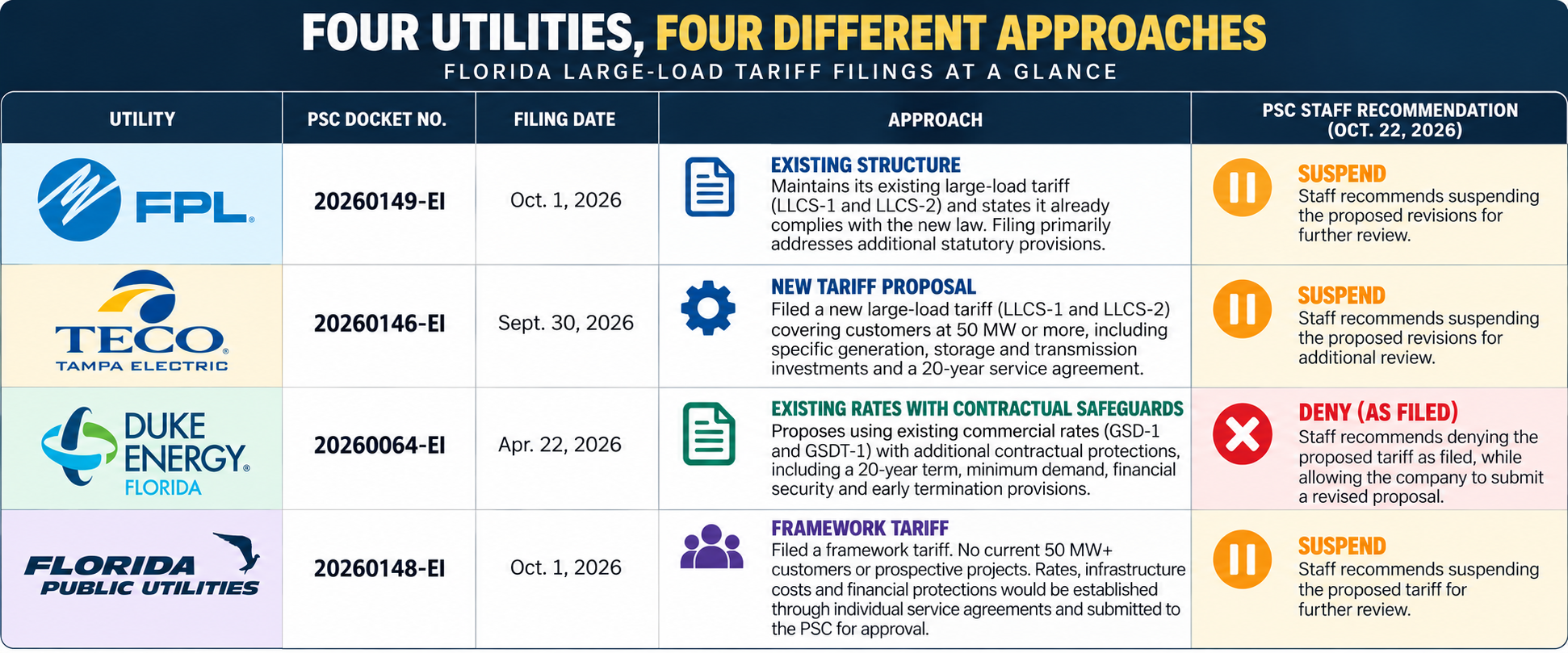
These differences matter because the PSC's decisions could influence how future large-load projects are evaluated throughout Florida.The Commission must determine whether each utility's approach satisfies the law—not simply whether a proposal contains provisions commonly associated with financial protection.
An Important Limitation: Rural Electric Cooperatives
One issue deserves attention beyond the four utilities currently under review. Florida's new large-load tariff requirements do not apply in the same manner to rural electric cooperatives and municipal electric utilities.
Section 366.043 applies to covered public utilities regulated under Chapter 366. Electric cooperatives and municipal electric utilities are excluded from the relevant statutory definition of public utility. This is particularly relevant in rural communities, where some future large-scale data center projects could seek development opportunities.
It does not mean cooperatives lack financial safeguards or that their customers are automatically exposed to additional costs. It means these utilities are not subject to the same state-mandated large-load tariff requirements and PSC review process established for investor-owned utilities.
As Florida evaluates its statewide approach to large-load electricity demand, policymakers should consider whether additional safeguards or reporting requirements are appropriate for electric cooperative and municipal utility service territories.
The Bigger Issue: Financial Risk Does Not Disappear Because a Contract Exists
Much of the discussion surrounding large-load tariffs focuses on long-term contracts, minimum payment requirements, and infrastructure contributions. However, their effectiveness depends on how they are structured and enforced.
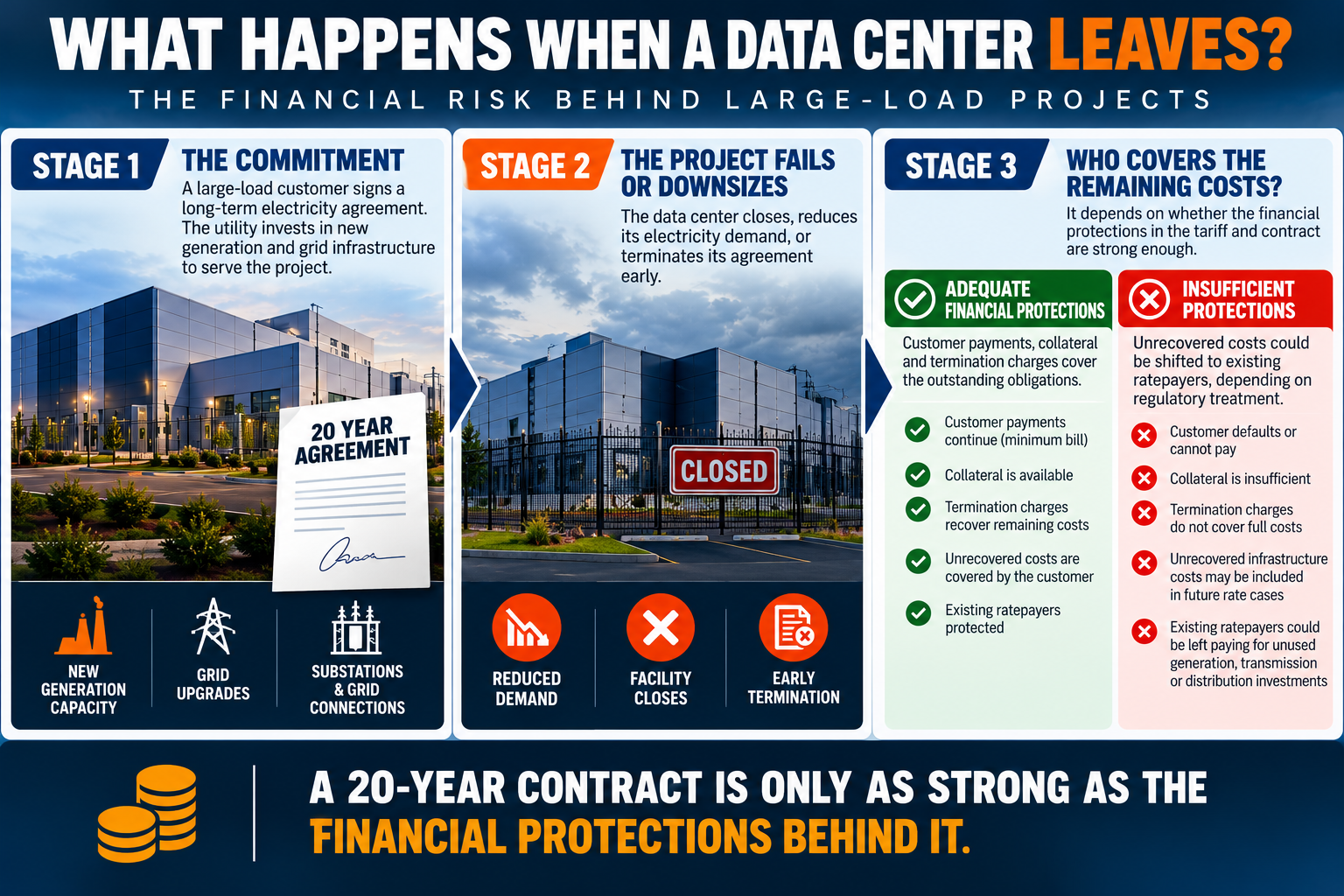
Consider a hypothetical project requiring substantial new generating capacity and transmission infrastructure. The developer signs a 20-year agreement, provides collateral, and commits to minimum electricity payments. Several years later, the project closes, reduces operations, or becomes financially insolvent.
The critical questions then become:
Is the collateral sufficient to cover outstanding obligations?
Do early termination payments recover the remaining investment?
Can the infrastructure be repurposed for other customers?
How are unrecovered costs treated in future utility rate proceedings?
Are existing customers protected from financial exposure associated with unused capacity?
These are fundamental questions about utility planning, financial risk, and regulatory oversight. A tariff's effectiveness should ultimately be measured by how well it allocates costs and protects customers when actual project conditions differ from initial forecasts.
November 3: The Next Regulatory Milestone
The Florida Public Service Commission is scheduled to consider the four utilities' large-load tariff proceedings at its November 3, 2026, agenda conference. The Commission may accept, reject, or modify staff recommendations, subject to the procedural requirements governing each docket.
For Duke Energy Florida, staff has recommended denial of the proposed tariff as filed. For Florida Power & Light, Tampa Electric, and Florida Public Utilities, staff has recommended suspending proposed tariff revisions to allow additional examination.
A suspension is not the same as a final rejection, and a staff recommendation is not a Commission decision. The November 3 meeting will help establish the next steps for these proceedings.
Sources & Regulatory References
Primary regulatory sources
Florida Public Service Commission — Duke Energy Florida
Docket No. 20260064-EI. October 22, 2026, staff recommendation concerning Duke's proposed large-load tariff.
Florida PSC docket records: https://www.floridapsc.comFlorida Public Service Commission — Tampa Electric Company
Docket No. 20260146-EI. October 22, 2026, staff recommendation concerning proposed large-load tariff revisions.
Florida PSC docket records: https://www.floridapsc.comFlorida Public Service Commission — Florida Public Utilities Company
Docket No. 20260148-EI. October 22, 2026, staff recommendation concerning the proposed Large Load Service tariff.
Florida PSC docket records: https://www.floridapsc.comFlorida Public Service Commission — Florida Power & Light Company
Docket No. 20260149-EI. October 22, 2026, staff recommendation concerning large-load tariff compliance revisions.
Florida PSC docket records: https://www.floridapsc.comFlorida Public Service Commission — November 3, 2026, Agenda Conference
Agenda conference materials and associated staff recommendations.
Florida PSC: https://www.psc.state.fl.us
Florida statutory references
Florida Statutes, Section 366.043
Large-load electric service tariff requirements, including cost responsibility and protections for existing ratepayers.Florida Statues: https://www.flsenate.gov
Florida Statutes, Section 366.02
Definitions applicable to Florida's electric utility regulatory framework, including the statutory treatment of investor-owned utilities, municipal electric utilities, and rural electric cooperatives.Florida Legislature: https://www.leg.state.fl.us/statutes/
This analysis is based on publicly available regulatory filings and PSC staff recommendations through October 24, 2026. Staff recommendations do not constitute final Commission action. The analysis distinguishes utility representations, staff findings, and outstanding regulatory questions.