
Florida Has Taken Action, but the Protections Are Weak
Matt Legge | Florida Data Center Watch
October 2026
Lawmakers have passed legislation to address the growing number of hyperscale data centers coming to Florida. But passing a law and actually protecting the public are two very different things. These massive facilities require enormous amounts of electricity, can use significant amounts of water, and often need major infrastructure improvements to operate. Those demands raise serious questions about who pays for the infrastructure, how our natural resources are protected, and what happens if a project fails or shuts down.
The legislation attempts to address some of these concerns, but it leaves too many important questions unanswered. For example, the law says data centers must pay their electricity costs, but whether that actually happens depends on how utility companies structure their agreements and whether regulators enforce the rules. The law also prohibits water use that would harm surrounding resources, but it doesn't establish one clear statewide measurement that residents can use to understand when the combined water use of these facilities becomes harmful.
And while local governments still have the authority to regulate development, many may not have rules specifically designed for facilities of this size. These aren't minor details. They're weaknesses that could leave residents, communities, and utility customers paying the price for decisions made today.
Hyperscale data centers aren't ordinary commercial buildings. Some proposed campuses could require hundreds of megawatts of electricity, enough to create major demands on the power grid. The legislation recognizes that these developments need oversight. Unfortunately, recognition alone doesn't provide protection.
Lawmakers have taken action. Now they need to fix what that action failed to address.
1. Ratepayer Protections Mean Little Without Enforcement
The law says large electricity customers must pay their full cost of service without passing those costs on to other utility customers. That sounds reasonable. But simply putting that requirement into law doesn't guarantee it will happen.
The Florida Public Service Commission (PSC), the state agency responsible for regulating investor-owned utilities, reviews the special rates and agreements utilities propose for these large customers. These agreements, called tariffs, determine how customers are charged and what financial protections are in place.
The problem is that the law's effectiveness depends on what those agreements actually require. And we're already seeing issues and projects have not even broke ground..
The Duke Energy Florida Example
On October 22, 2026, PSC staff recommended rejecting Duke Energy Florida's proposed large-load tariff.
Staff raised concerns about which customers the proposal would cover and whether the utility had adequately demonstrated that those customers would pay their full cost of service. This was a staff recommendation, not a final decision. The Commission is scheduled to consider the matter on November 3, 2026, but the concern is straightforward.
Lawmakers passed legislation requiring utility customers to be protected, yet regulators are already questioning whether a proposed utility agreement actually meets that requirement.
Consider what happens if a utility company spends millions building new infrastructure for a data center that later cancels its expansion plans or closes. The infrastructure doesn't simply disappear. The utility still has to recover the money it spent.
Without strong financial protections, other customers could be left covering costs associated with a development they had nothing to do with. That's the risk lawmakers are supposed to prevent.
What Needs to Change
Lawmakers and regulators should require:
Financial guarantees that protect existing customers if a data center fails or closes.
Contracts requiring large customers to pay for the infrastructure built specifically to serve them.
Clear rules preventing unpaid infrastructure costs from being passed on to other customers.
Public information explaining how major infrastructure costs are divided.
Regular reviews comparing how much electricity a data center promised to use with how much it actually uses.
Public reporting of the financial risks tied to these large customers.
Some of these protections are already allowed under existing law. The issue is making sure they are strong enough and consistently enforced. If a private development creates the need for expensive infrastructure, the people and businesses creating that demand should be responsible for the costs. Not everyone else.
2. Prohibiting Harmful Water Use Is Not Enough
Existing legislation says large-scale data centers cannot receive approval for water use that would harm the area's water resources.
That sounds good. But there's a problem. The law says harmful water use is prohibited, but it doesn't establish one clear statewide measurement showing when the combined water use of these facilities becomes harmful.
Water management districts already use scientific and technical standards to review water permits. Those standards serve an important purpose. However, residents should be able to understand how officials reached the conclusion that a proposed development won't harm their local water supply. That becomes even more important when several large facilities are planned in the same area.
The 100,000-Gallon Threshold Is Not a Safety Limit
The legislation requires additional water-use information and conservation planning when certain proposed water allocations reach 100,000 gallons per day.
But here's what people need to understand. That number is not a safety limit.
A facility using 99,000 gallons per day isn't automatically safe. The 100,000-gallon threshold simply triggers additional requirements. It doesn't tell us how much water an area can safely provide or how multiple developments might affect the same water supply. For example, imagine five data centers proposed in the same region. Each applies for its own water permit. Each may meet the applicable permitting requirements. But what happens when you consider the combined demand of all five facilities?
What Happens During a Drought or Natural Disaster?
There's another issue the legislation fails to adequately address: What happens when water supplies become critically low? Florida already has laws allowing water management districts to restrict water use during droughts and emergencies. But the data center legislation doesn't establish specific requirements explaining how these massive facilities must reduce consumption when communities are facing water shortages. What happens during an extended drought, a hurricane, or a major disruption to the public water supply? Will facilities be required to reduce their water use? Do they have backup water sources? And how will those decisions affect nearby homes, businesses, and agricultural operations? Residents should never be left wondering whether their access to water will be protected when supplies become scarce.Lawmakers should require data centers to have drought and emergency water-management plans, including clear procedures for reducing consumption and protecting essential community water needs.
What Needs to Change
Lawmakers should require:
Clear explanations of how harmful water use is determined.
Reviews that consider the combined water demands of nearby developments.
Public reporting of how much water facilities expect to use and how much they actually consume.
Ongoing monitoring of major water users.
Stronger conservation requirements in areas where water supplies are already under pressure.
Greater consideration of recycled water and cooling systems that use less water.
Required drought and emergency water-management plans for major data centers.
Clear procedures for reducing industrial water use during shortages, with protections for essential community water needs.
Different regions have different water resources, so a single statewide consumption limit may not make sense. But the public deserves to know how decisions are made, whether local water supplies can support these developments over time, and what happens when those supplies become limited by droughts or natural disasters. Saying harmful water use is prohibited means little if residents cannot clearly see how that protection is measured, enforced, and maintained during a water shortage. Lawmakers need to ensure that protecting essential community water needs remains a priority, especially when water becomes scarce.
3. Local Governments Have Authority, but Many Lack the Rules
The legislation allows counties and cities to continue making their own land-use and development decisions. As it should to preserve Home Rule. But giving local governments authority doesn't automatically mean they have the right rules in place. As I continue to research, what I’m finding is that some counties and municipalities have already started creating specific regulations for data centers, while others still rely on zoning rules originally written for warehouses, manufacturing facilities, and other industrial developments.
The problem is that a hyperscale data center isn't simply another warehouse. These facilities can require massive amounts of electricity, cooling equipment, backup generators, and major utility improvements. They may also create concerns about noise, nearby homes, agricultural land, and emergency services. Yet some local governments may be reviewing these projects under rules that were never designed for developments of this size.
Lawmakers left counties and cities responsible for regulating hyperscale development without establishing a clear set of minimum standards to guide them.
What Needs to Change
The Legislature should establish basic statewide development standards that address:
Clear zoning classifications for hyperscale data centers.
Required information about electricity, water, and infrastructure needs.
Noise, lighting, cooling equipment, and backup generator impacts.
Protections for nearby homes and agricultural properties.
Emergency-response planning.
Public hearings before major projects receive approval.
Local governments should still be allowed to establish stronger rules based on the needs of their communities. The state should set minimum requirements, not take away local decision-making authority.
Local control is important. But local governments need the right information and standards to make informed decisions.
4. A 50-Megawatt Facility Is Not the Same as a 500-Megawatt Campus
Current legislation uses a 50-megawatt threshold to identify certain large electricity customers. That makes sense as a starting point. But there's a major difference between a facility requiring 50 megawatts and a campus requiring 500 megawatts. A larger development may need more power lines, substations, electricity generation, land, and supporting infrastructure. The potential financial and environmental impacts can also be much greater. Yet the legislation doesn't establish a complete system that increases oversight as these developments get larger.
Lawmakers created a threshold for identifying large electricity customers but stopped short of establishing stronger requirements for projects with much greater infrastructure demands.
What Needs to Change
Oversight should increase with the size of the development.
One possible approach would be:
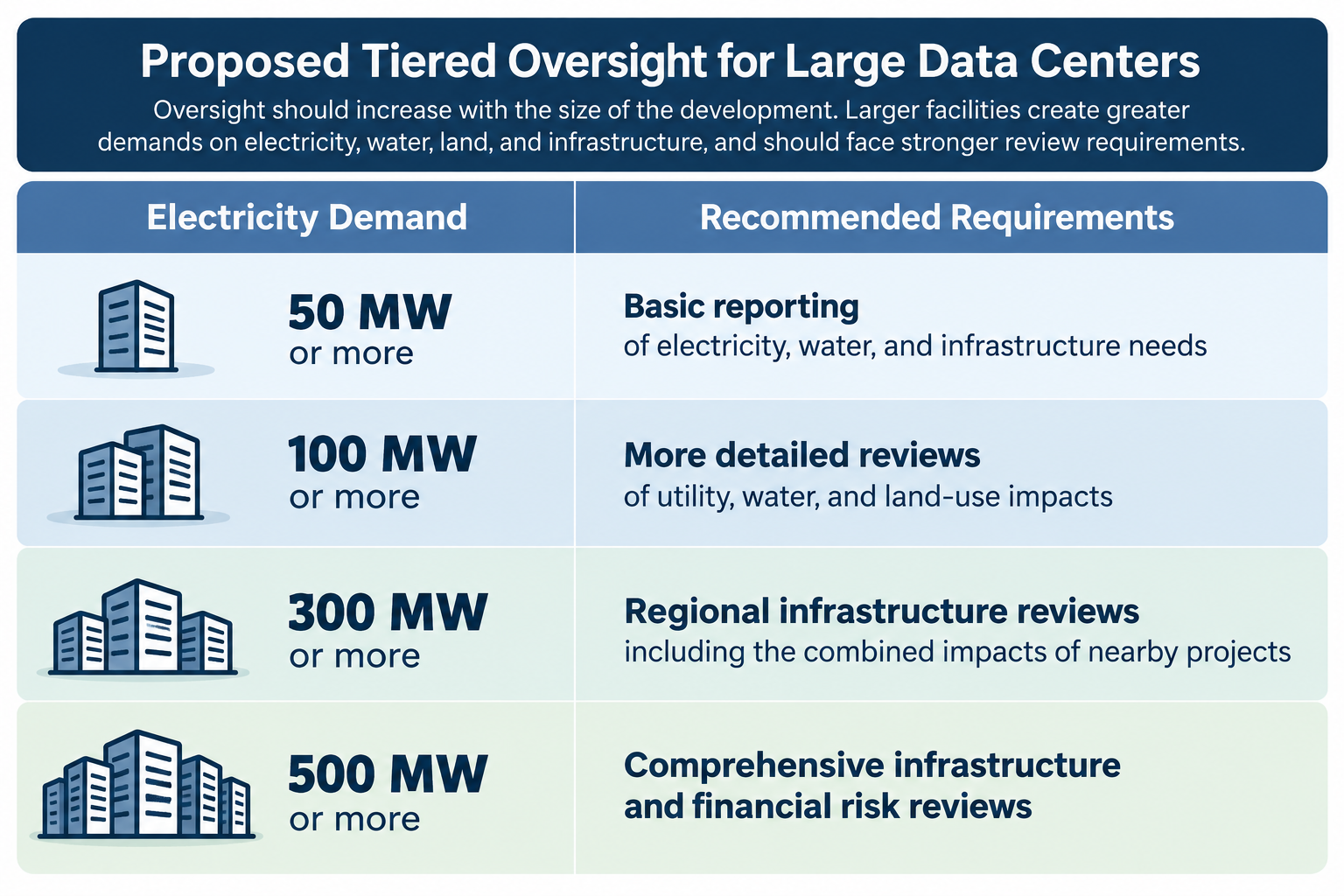
They should also apply to the entire planned development, including future phases. Otherwise, a developer could potentially divide a large project into smaller pieces to avoid stricter requirements. A project ten times larger shouldn't automatically face the same level of review. The rules need to reflect the size of the risk.
5. Agricultural Land and Abandoned Facilities Remain Unaddressed
Hyperscale data centers can require large amounts of land. Agricultural properties may be attractive because they offer the space needed for major development. But once farmland is converted into an industrial site, returning it to agricultural use may be difficult or expensive. That raises concerns about permanently losing productive land and changing the character of surrounding communities.
Existing zoning and environmental laws provide some protections. However, the legislation does not establish a dedicated statewide system for protecting agricultural land from poorly planned hyperscale development. It also doesn't require a specific statewide decommissioning bond for these facilities.
A decommissioning bond is essentially financial security set aside to help cover the cost of closing a facility, removing structures, and restoring a property when required.
Why does that matter? Because facilities don't operate forever. Projects can fail, companies can close, technology can change, and buildings can eventually become obsolete. When that happens, someone may be responsible for removing structures, addressing environmental issues, and restoring the property.
Those responsibilities should be established before construction begins, not after a developer or operator walks away.
What Needs to Change
Lawmakers should require:
Stronger reviews before converting agricultural land into hyperscale industrial developments.
Consideration of existing industrial properties before converting farmland.
Plans explaining how facilities will be closed and sites restored.
Financial guarantees to cover reasonable restoration costs.
Regular updates to those guarantees as costs change.
These requirements should reflect the actual risks associated with each development.
Developers should be responsible for the long-term consequences of their projects. Communities should not be left dealing with abandoned facilities and unpaid cleanup costs.
6. Public Records Are Available, but Transparency Is Still Weak
The state has public records laws that allow residents to request and review government information, but that doesn't mean information about hyperscale data centers is easy to find. Anyone who has tried researching one of these projects knows how scattered the information can be.
A county may have the zoning documents, a water management district may have the water permits, a utility company may have the electricity demand estimates, the Public Service Commission may have information about infrastructure costs, and economic development offices may hold additional records, but residents are often left trying to piece it together themselves.
Making records available doesn't automatically make government transparent.
What Needs to Change
Lawmakers should require basic public reporting for major data center developments.
That information should include:
Who is developing the project.
Where it will be built and how much land it will use.
How much electricity it is expected to require.
How much water it is expected to use.
Which permits have been requested or approved.
What major infrastructure improvements are needed.
When public hearings and government decisions are scheduled.
The state should also create a central location where residents can find this information without searching multiple agencies.
Sensitive security information and legally protected business information should remain protected, but those protections should not become an excuse for withholding information the public needs to understand government decisions.
Residents shouldn't have to spend hours searching government websites just to understand what's being proposed in their own communities.
7. Reviewing Projects One at a Time Isn't Enough
Right now, different agencies review different parts of a proposed development.
Local governments review zoning and land use.
Water management districts review water permits.
Utilities evaluate electricity demand.
Each agency has a responsibility, but there isn't a single, comprehensive statewide process specifically designed to evaluate the combined regional impacts of multiple hyperscale developments.
That's a serious weakness.
Imagine several large data centers being proposed within the same county or surrounding counties. Each project may meet the requirements for its individual permits, but together, those facilities could require major electrical upgrades, large amounts of water, and significant land development. Those combined demands could affect infrastructure planning across an entire region.
If government agencies are only looking at their individual responsibilities, important concerns may not receive the attention they deserve.
What Needs to Change
Lawmakers should require regional infrastructure reviews when multiple large developments are proposed within the same area.
Those reviews should examine:
The total electricity demand of the proposed facilities.
Whether existing power infrastructure can support that demand.
How much water the developments would require together.
How surrounding communities and agricultural properties could be affected.
What new infrastructure would need to be built.
Who would pay for those improvements.
Whether the region can reasonably support the proposed development.
Agencies should share information and coordinate their findings instead of creating unnecessary new layers of government.
Looking at each project separately doesn't always tell us what happens when several of them are built in the same region.
8. Another Study Doesn't Replace Stronger Protections
The Legislature has ordered an independent study examining the impacts of large-scale data centers. The study, commissioned through the Office of Program Policy Analysis and Government Accountability (OPPAGA), is due July 1, 2027. It will examine issues such as economic development, electricity demand, utility costs, natural resources, public health, and safety.
That’s great, but let's be clear.
A study is not a protection. It doesn't guarantee that utility customers won't pay for infrastructure built for private developments, it doesn't require developers to provide financial security for abandoned facilities, it doesn't establish stronger local development standards, and it doesn't create a system for evaluating the combined infrastructure demands of multiple projects.
Those are issues lawmakers should be addressing right now.
The study should help identify additional concerns, improve existing requirements, and guide future legislation, but it shouldn't become a reason to delay action on weaknesses that are already apparent.
Where regulators already have the authority to act, they should use it. Where existing laws are inadequate, lawmakers should strengthen them.
We don't need to wait until 2027 to recognize that developments of this size require stronger oversight.
The Legislation Is Not Strong Enough
Lawmakers have taken action on hyperscale data centers, but the protections remain weak.
The legislation says large electricity customers must pay their own costs, yet the effectiveness of that requirement depends on utility agreements and regulatory enforcement.
It prohibits harmful water use but doesn't establish one clear statewide measurement for determining when the combined water demands of these facilities become harmful.
It allows local governments to regulate development but doesn't provide comprehensive minimum standards designed specifically for hyperscale facilities.
It identifies large electricity customers without requiring progressively stronger reviews as projects grow.
It leaves important gaps involving agricultural land, abandoned facilities, regional infrastructure planning, and public transparency.
These are not small issues. They involve decisions that could affect communities and utility customers for decades. The answer isn't necessarily to stop hyperscale data center development. It's to establish rules that protect the public while allowing responsible development to move forward.
That means making sure private developments pay their own costs, natural resources are protected, local governments have the tools they need, and residents can see how decisions are being made.
Passing legislation doesn't automatically mean the problem has been solved. Lawmakers have acknowledged the risks. Now they need to address the weaknesses in the laws they passed.
Residents shouldn't have to wait until they're facing higher infrastructure costs, water shortages, or abandoned industrial sites before those protections are strengthened.
Responsible development requires more than promises. It requires clear rules, strong enforcement, and accountability.
Sources and References
The following government records, legislation, and regulatory proceedings provide the legal and factual foundation for this analysis.
1. Florida Senate Bill 484 (2026) | Data Centers
Florida Legislature
View legislation and bill history
Primary legislation addressing large-scale data center development, electricity costs, water consumption, local government authority, and related regulatory requirements.
2. Senate Bill 484 | Enrolled Legislation
Florida Legislature
Read the enacted legislative text
Provides the statutory language used to evaluate the legislation's requirements, limitations, and areas where additional protections may be warranted.
3. Section 366.043, Florida Statutes | Large-Load Electricity Customers
Florida Legislature
Review statutory provisions
Addresses utility cost recovery, large electricity customers, and financial protections intended to prevent costs from being shifted to other ratepayers.
4. Florida Public Service Commission | Docket No. 20260064-EI
Duke Energy Florida Large-Load Tariff Proceeding
Access Florida PSC docket records
Regulatory proceeding concerning Duke Energy Florida's proposed large-load tariff, including the October 22, 2026, staff recommendation and subsequent Commission review.
5. Section 373.262, Florida Statutes | Large-Scale Data Center Water Permits
Florida Legislature
Review statutory provisions
Establishes water permitting requirements, conservation measures, and restrictions concerning harmful water-resource impacts.
6. Section 163.326, Florida Statutes | Local Government Authority
Florida Legislature
Review statutory provisions
Addresses local government authority over land-use planning and development decisions involving qualifying data center projects.
7. Section 288.075, Florida Statutes | Economic Development Confidentiality
Florida Legislature
Review statutory provisions
Provides the legal framework for confidentiality protections involving certain economic development records and related public disclosure considerations.
8. OPPAGA | Independent Large-Scale Data Center Study
Florida Legislature, Senate Bill 484
Review study requirements
Establishes requirements for an independent study examining the economic, environmental, infrastructure, utility, and public health impacts of large-scale data centers. The report is due July 1, 2027.
9. Section 373.246, Florida Statutes | Water Shortages and Emergency Restrictions
Florida Senate: Declaration of Water Shortage or Emergency
Establishes the authority of water management districts to restrict water use during shortages and emergencies.
10. Southwest Florida Water Management District | Water Shortage Restrictions
Official Water Shortage Information
Policy Analysis and Recommendations
The findings and legislative recommendations presented in this article are independent policy proposals developed by Matt Legge through the Florida Data Center Watch initiative.
Proposed measures, including tiered oversight thresholds of 50, 100, 300, and 500 megawatts, additional financial safeguards, agricultural land protections, decommissioning requirements, and regional infrastructure reviews, are recommendations for legislative consideration.
These proposals should not be interpreted as existing statutory requirements unless expressly identified as such.
This analysis is based on legislation and regulatory information available as of October 25, 2026.